

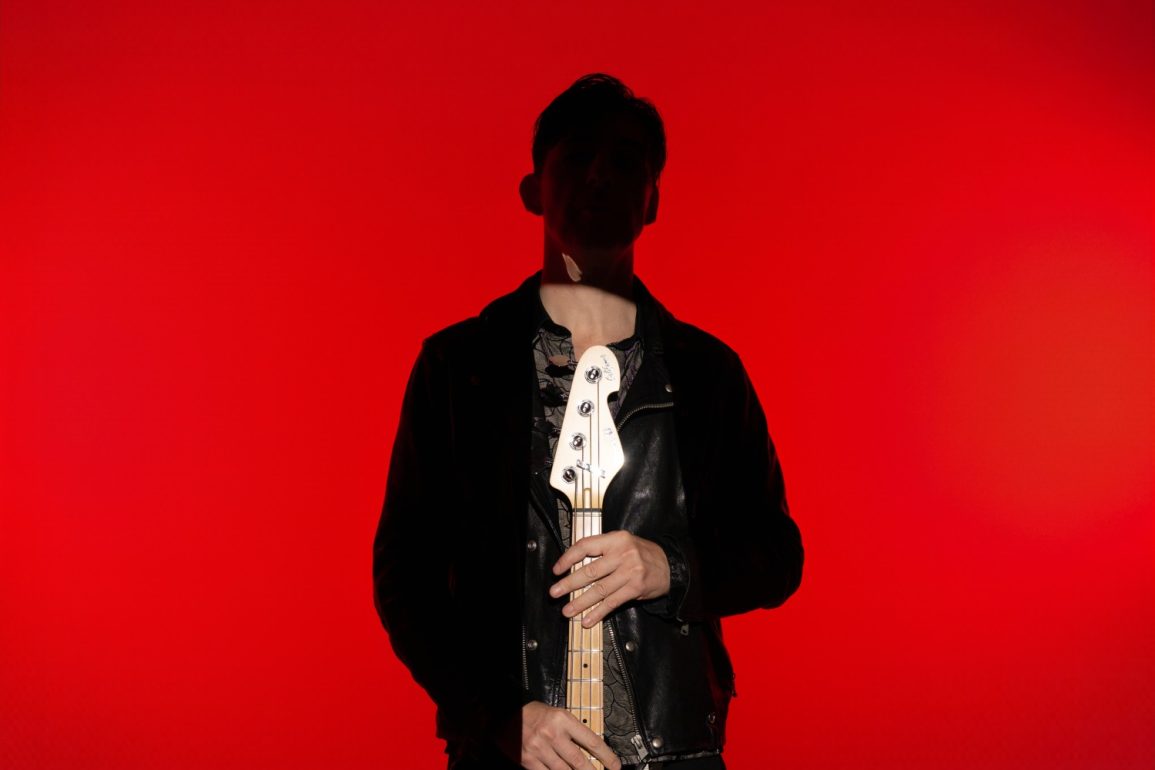
London-based songwriter and bassist Sam Gino, under the moniker SAMLOW, is carving out a distinct presence in the alt-rock and new-wave scene. His debut single ‘Magazine’ drew critical attention from UK press and radio, reached over 600,000 listeners, surpassed 26,000 Spotify streams within weeks, and earned nods from Duran Duran and Anna Ross, as well as a feature on Italy’s RAI 3. Now, SAMLOW returns with his second single, ‘Red Riot’. Co-written with Bnann Infadels and produced by Gareth Young at Cube Recording Studios in Cornwall, the track delivers anthemic choruses and a driving, bass-heavy sound, offering a pointed reflection on social inertia and the search for authentic connection. Gino’s approach is shaped by more than a decade as a touring bassist, with extensive performances across Europe, the UK, the US, and Australia, refining a style rooted in live energy and musical precision.
In our latest interview, SAMLOW dives into the stories, struggles, and vision behind ‘Red Riot’ and what’s next for his rapidly rising project.
After years immersed in the rhythm section on tour, what compelled you to carve out your own creative path as SAMLOW, and how did that transition reshape your artistic vision?
After a decade of driving other people’s vehicles, the songs inside my head just became too loud to ignore. It wasn’t a calculated move: it was an artistic necessity. The bass is still my weapon of choice, but now it also serves my own narrative.
What is one moment from your time connecting with fans in Europe, the UK, the US, and Australia; including three tours in Australia, that has stuck with you?
Out of all the miles, that first night at the Factory Theatre in Sydney in 2025 with Absolute Bowie stands out. It was our third Australian tour, and the crowd was relentless. Locking eyes with the front row and feeling that collective roar, I recognized fans from previous years. That entire tour was amazing: seeing familiar faces down under is a rare, unique connection: something my teenage self, dreaming up imaginary tours, would never have believed. Period.
Coming from the natural isolation of the Italian Alps to the connected world of London, how does that contrast shape the emotional tension in your music?
My music lives precisely in the friction between those two worlds: mountain silence and relentless urban energy. The isolation of my roots taught me how to look inward, while London forces that tension to erupt.
With ‘Magazine’ earning radio play and recognition from Duran Duran, what aspects of the audience’s response most challenged or surprised your expectations?
Seeing the track hit over 600,000 listeners and being reposted by icons like Duran Duran was completely surreal. It instantly told me to trust my instincts more.
Can you describe the creative dynamic that unfolded while co-writing with Bnann Infadels and working with Gareth Young at Cube Recording Studios, and how that environment shaped the final sound?
Instant synergy. Working down at Cube Recording Studios in Cornwall isolated us from the noise, forcing us to focus entirely on the raw tracks. Gareth, as producer and top drummer, drove the track’s massive sonic weight, while Bnann added that sharp swagger. We wanted a volcanic live feel, not a polite studio record. I felt like I was eventually finding the exact sound I’ve been looking for for years.
What personal experiences or moments ignited the themes of resistance and connection that pulse through ‘Red Riot’?
It came from looking at a world where everyone is digitally hyper-connected, yet completely isolated. Politicians are cutting corners, systems are imbalanced, and there’s this heavy social inertia. ‘Red Riot‘ is the boiling point: a definitive wake-up call to take the power back.
In channeling the ‘volcanic warning signal’ energy and Drop D motif of ‘Red Riot’, what internal or creative tensions surfaced during the songwriting process?
As a bassist, I think in low frequencies. Tuning to Drop D gave us that heavy, underground earthquake riff effect, which was the perfect sonic match for the lyrics “volcano and warning”. The real creative tension was avoiding a predictable verse-to-chorus transition. We intentionally kept the verses driving and restrained, locking in that volcanic warning signal so that when the anthemic chorus finally lands, it hits twice as hard. I’m also incredibly happy with how the music video turned out: it perfectly reflects that exact cinematic vision we built in the studio.
With ‘Red Riot’ capturing a sense of urgency and authenticity, what possibilities or directions excite you most as SAMLOW moves forward?
Taking this raw, cinematic energy straight to the live stage. The response from the press, like Clash Magazine, has been incredible. It opens up a lot of room for experimentation. The focus now is just to keep building on this foundation: it’s all about how the project can evolve with each release.
As someone positioned at the intersection of alt-rock and new indie wave, what long-term effects do you anticipate AI having on the genre’s evolution and its connection to live performance culture?
AI can replicate a formula, but it cannot sweat. It hasn’t spent ten years crammed in the back of a touring van, and it doesn’t know the feeling of a room erupting at 11 PM. The rise of AI will actually make authentic live performances and real human flaws much more valuable.
If you could relive one moment from your touring days with fresh eyes as the artist you are now, which one would it be and why?
Stepping for the first time onto the stage at London’s O2 Shepherd’s Bush Empire in 2023 with AB. I can still vividly remember the emotion of looking through those red curtains right before the gig. It was even more special because my parents had traveled all that way just to see me perform that night.
Stream ‘Red Riot’: